

When Elon Musk first took the stand this week, he described his lawsuit against Sam Altman and OpenAI in cataclysmic terms. “If we make it okay to loot a charity,” he said, speaking about OpenAI’s conversion into a for-profit structure, then “the entire foundation of charitable giving in America will be destroyed.” He even warned that Musk v. Altman risks becoming infamous “case law,” should the nine-member jury at Oakland’s Ronald V. Dellums U.S. Courthouse not rule in his favor.

Musk set the sky-high stakes. Given the gravity of the situation, one might expect him to do some research and come prepared for Wednesday’s cross-examination. Instead, under questioning from OpenAI lead attorney William Savitt, Musk quibbled, argued, complained, obfuscated—and more than anything, came across like he hadn’t actually put much thought into the lawsuit that he filed.
“Your questions are not simple,” he told Savitt, who got under Musk’s skin by repeatedly assuring him that he was posing straightforward inquiries. “They’re designed to trick me, essentially.”
Despite the best efforts of Judge Yvonne Gonzalez Rogers and others working at the courthouse, Wednesday’s proceedings were an unavoidable circus. Even casual followers of the Musk v. Altman case were aware that Musk was going to be on the stand for hours. He was the hottest ticket in town.
I got to the entrance of the courthouse at 6:15 a.m., and was the 17th person to join the queue outside. The first 30 or so people in the queue are, in theory, given designated courtroom spots for the day, and everyone else packs into a different room with a video feed. A group of college students, as well as a handful of people who I will politely describe as fans of Elon Musk, showed up early enough to make the cut for the courtroom. The non-media attendees threw a wrench in the plans of a handful of late-arriving journalists, a few of whom slyly cut the line before they were called out. (I am not going to name and shame anyone, but if you’re one of the offenders reading this, know that I think less of you!)
I (barely) made it into the courtroom, and walked into a bizarre scene. Gonzalez Rogers was reprimanding someone for apparently taking a photo of Musk. The offender pleaded ignorance, claiming that they did not properly read the many signs saying “no photography or recording,” because they have dyslexia. This person spent the morning ahead of me in the queue, hitting their vape and taking endless selfies.
Musk’s lead attorney, Steven Molo, kicked things off by completing Musk’s direct examination. He got a few solid jabs in, especially by raising embarrassing 2018 emails from cofounders Greg Brockman and Ilya Sutskever, where they both praised Musk for his counsel and partnership. Molo’s goal was to portray Musk as a vital part of getting OpenAI up-and-running—someone who contributed funding and sweat equity.
In Musk’s retelling, he began doubting the motives of OpenAI’s cofounders around 2017, though he did not ditch them yet. Yes, he discussed a for-profit subsidiary around then, which on its face is exactly what he now finds objectionable about OpenAI. And yes, he floated a 51% stake in this for-profit subsidiary, which would’ve been far more than the stakes he recommended for Altman, Brockman, and Sutskever. But his stake would’ve diluted over time, he claimed, after new investors became board members themselves. As long as the for-profit portion of OpenAI remained a subsidiary of the nonprofit, then the arrangement would be ethical, Musk concluded.
If you squint, Musk isn’t being a complete hypocrite here. In fact, he and his attorneys have been consistent that he doesn’t object to the concept of a capped, for-profit subsidiary of a nonprofit. Musk’s issue is that, in his opinion, OpenAI eventually abandoned its original altruistic mission. It is now solely driven by profit, even if there’s a nonprofit foundation that retains “control” over the rest of the company. “That’s having your cake and eating it too,” Musk said on the stand.
Many people agree with his general point! Unfortunately for Musk, the jury and Gonzalez Rogers are not ruling on whether he has a general point. They’re ruling on demonstrable claims of “breach of charitable trust” and “unjust enrichment.”
After a 20-minute break, it was time for Musk’s cross-examination with OpenAI’s attorney, Savitt. A handful of people who’d been in the video feed room snuck their way into the courtroom, though they got the boot when their intrusion was discovered. A very snuggly couple managed to stick around for a little bit while Musk’s testimony went off the rails. One of the college students fell asleep.
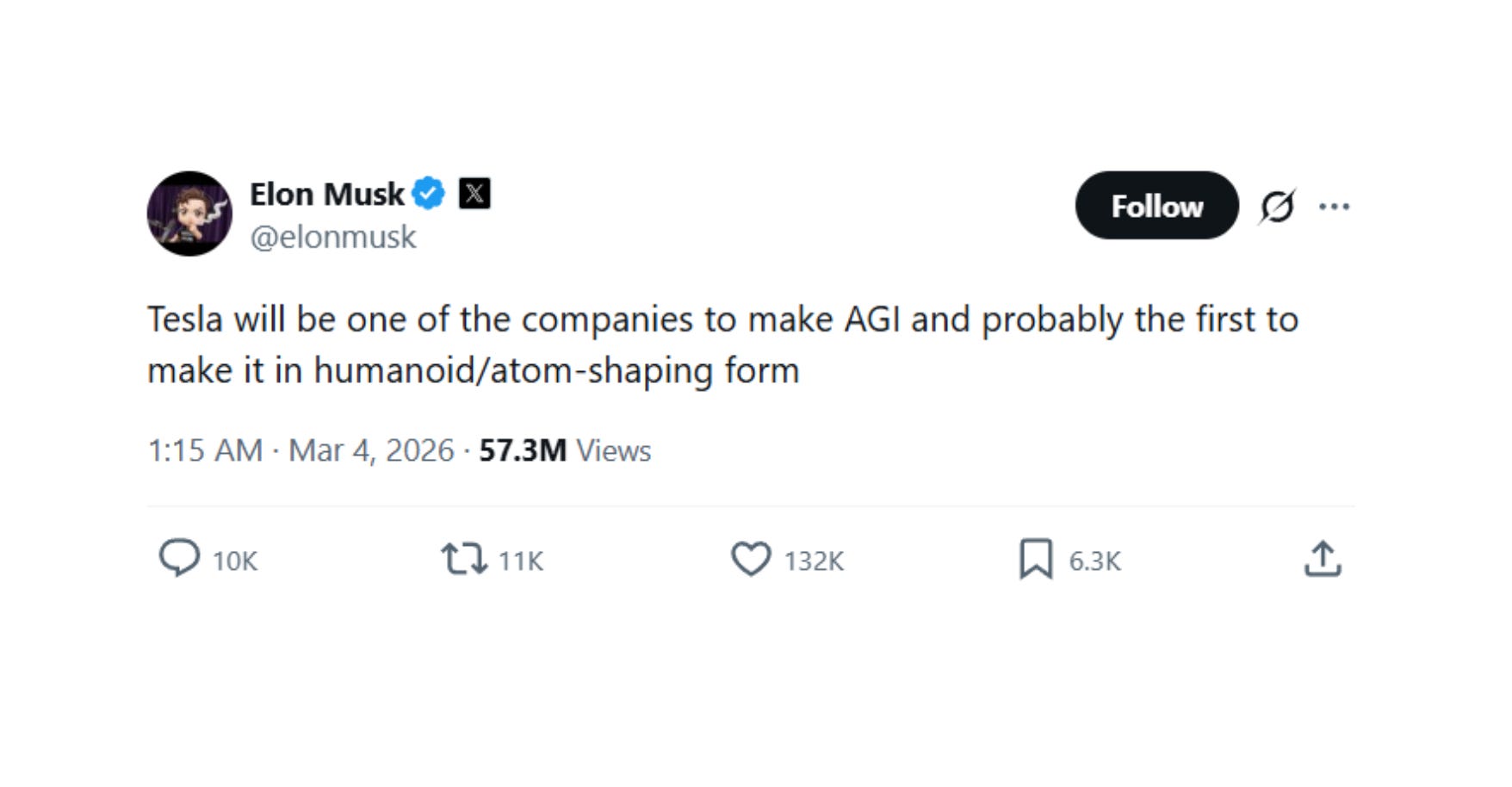
That student missed a lot. Savitt began by tying Musk in knots. He mentioned a passing comment from Musk’s earlier testimony, when he said, “No, Tesla is not pursuing AGI. It’s literally trying to make a car drive from A to B.” Savitt pulled up an X post from Musk, dated March 4, 2026: “Tesla will be one of the companies to make AGI and probably the first to make it in humanoid/atom-shaping form,” he wrote. The best rebuttal Musk could muster is that Tesla will be pursuing AGI in the future, which is different from pursuing it in the present-tense.
Savitt had no trouble painting Musk as an unreliable narrator. He pulled up another X post, dated to March 15, 2023, when Musk asserted that he had given $100 million to OpenAI. That number is significantly more than the $38 million figure established in this lawsuit. Again, Musk tried to muster a rebuttal, but it fell even flatter. Savitt referenced Musk’s deposition from a year ago, when Musk admitted that the figure in his March 2023 post was “mistaken.”
Musk grew impatient with Savitt’s questions. “Any simple answer would be misleading the jury,” he protested, after Savitt requested that he resist the urge to grandstand. Musk invoked the “have you stopped beating your wife?” fallacy, to which Gonzalez Rogers issued a rare interjection: “No, we aren’t going to go there,” she said.
The rest of Musk’s Wednesday testimony could best be characterized as “not helpful to his case.” He produced a series of soundbites that elicited laughter, confusion, and I would guess migraines from his lawyers. A selection of moments:
“I got along with almost everyone, almost all the time” at OpenAI, he said of his relationships with employees.
“Your questions are definitionally complex, not simple,” he doubled down to Savitt. “It is a lie to say they are simple.”
“I think so,” Musk said, when asked if he was romantically involved with Shivon Zilis in February 2018. Musk and Zilis live together, he belatedly stated on Wednesday, and they have four children. She remained on the OpenAI board for a number of years, even after Musk left the organization.
“I did not read the fine print,” Musk said of a term sheet that Altman sent him in 2018. Savitt’s reply: “It’s a four-page document.” Musk had additional opportunities to read the term sheet before he took the stand—he surely knew he was going to be asked about it—but he did not do so.
Musk said he doesn’t know what an AI safety card is, and he struggled mightily to identify specific safety concerns he has about OpenAI.
Time and time again, Musk came across as vindictive and out-of-the-loop, not someone who’s been diligently studying OpenAI’s greed-driven industry takeover. Savitt noted that in 2019, Altman contacted Musk, asking to get some advice about Microsoft’s impending investment in OpenAI. Musk didn’t respond. In October 2020, Altman again reached out for Microsoft advice. Musk confirmed that he and Altman talked, though he doesn’t remember the details. In January 2023, Microsoft invested another $10 billion in OpenAI. Musk said he doesn’t remember hearing anything about the expanded deal from Zilis, his quasi-romantic partner who was still on OpenAI’s board.
Of course, if Zilis was secretly gossiping with Musk, that’d be a problem too. But Savitt’s line of inquiry was more so intended to show that Musk’s fatalistic rhetoric doesn’t align with his seeming lack of interest in OpenAI’s actual conversion into a for-profit structure. In fact, Musk’s lawsuit wasn’t filed until after he started xAI as well as Grok, his perverted chatbot.
Savitt actually offered Musk an opportunity to argue that xAI and Grok are not on the level of OpenAI, and thus, his lawsuit has nothing to do with going after a competitor. But Musk decided to drop his humble savior act; his hubris and argumentative impulses got the best of him.
“Grok lags far behind ChatGPT, fair?” Savitt asked.
Musk’s reply? “Not anymore.”
Is there anyway they BOTH can lose? That would be true justice.
So smart that he barrelled into that one 🙄